
Fiber Choice Directly Impacts Product Performance
Choosing a fiber or prebiotic for a formulation is not a minor decision. The ingredient of choice affects texture, stability, digestive tolerance, and even whether a product succeeds in the market.
Ingredients such as inulin, resistant dextrin, polydextrose, and isomalto oligosaccharides (IMO) are often grouped together, but in practice, they behave very differently and offer distinct advantages in applications.
Our team conducted a comprehensive systematic review of these four ingredients across four areas that matter most to formulators:
- Functional performance in food and beverage applications
- Fermentation behavior
- Gastrointestinal tolerability
- Health benefits
The differences are not subtle. They directly impact how a product performs during processing and the end result that is delivered to a customer.
How These Ingredients Differ
At a high level, each of these ingredients solves a different problem in a formulation.
Inulin is often used when texture or fat replacement is a priority, but it ferments quickly and can create challenges with digestive tolerance, particularly at higher inclusion levels.
Resistant dextrin is widely used in beverages because it dissolves easily, has little impact on sensory properties, and is generally well tolerated even at high inclusion rates. Gastrointestinal symptoms remain mild and transient even at levels as high as ~40g/day.
Polydextrose is valued for its stability and ability to provide bulk in reduced-sugar systems.
IMO functions differently from traditional fibers, offering mild sweetness and texture support while also contributing prebiotic activity.
These differences come down to structure, which ultimately determines how each ingredient behaves both in the product and in the body.

How Fermentation Rate Affects Tolerance and Performance
One of the most important differences between these ingredients is how quickly they are fermented by the gut microbiota.
Inulin is rapidly fermented in the colon, which leads to strong production of short-chain fatty acids and selective stimulation of beneficial bacteria. However, this rapid fermentation also increases gas production, which can result in bloating or discomfort at higher intake levels.
In contrast, resistant dextrin and polydextrose are fermented more slowly. This slower fermentation leads to a more gradual production of metabolites and tends to improve gastrointestinal tolerance. These ingredients are often better suited for applications with higher inclusion levels.
Isomalto oligosaccharides sit somewhere in the middle. IMO is partially digested in the small intestine and only moderately fermented in the colon. As a result, it delivers some prebiotic functionality while generally producing fewer gas-related side effects.
From a formulation perspective, fermentation speed is not just a nutritional detail, but rather directly impacts how consumers experience the product.
Why Some Ingredients Cause More GI Discomfort Than Others
Digestive tolerance becomes increasingly important as inclusion levels of functional oligosaccharides and dietary fibers increase in a formulation.
Inulin is generally well tolerated at lower intake levels (approximately 5–20 g/day), but higher amounts are more likely to increase gas production and bloating, particularly in sensitive individuals, such as those with IBS.
In contrast, resistant dextrin and polydextrose—both recognized dietary fibers—are typically better tolerated, even at higher intake levels. While some initial gas production may occur at the higher intake levels, symptoms often decrease over time as the gut microbiota adapts.
IMO, as a soluble prebiotic oligosaccharide, also demonstrates good tolerance in clinical settings, with minimal differences compared to standard carbohydrate controls.
This distinction becomes especially important in products delivering higher levels of functional carbohydrates, such as:
- Beverages or foods delivering 8–15 g of added fiber per serving
- Daily-use functional products
- Products positioned around digestive or metabolic health
For example, a beverage formulated with a rapidly fermenting dietary fiber at 10–15 g per serving may increase the likelihood of bloating. In contrast, a formulation built around more slowly fermenting ingredients is more likely to be tolerated with repeated daily use.
.png)
How Different Fibers and Prebiotics Perform in Food and Beverage Formulation
These ingredients behave very differently once they are in a formulation.
Inulin is often used to build texture. It can form gel-like structures that create creaminess and mimic fat, which makes it useful in dairy and reduced-fat applications. However, it can also crystallize or precipitate under certain storage conditions, which may affect product stability.
Resistant dextrin is one of the most neutral ingredients from a sensory standpoint. It dissolves easily, contributes minimal viscosity, and does not significantly impact taste. This makes it particularly useful in beverages where clarity and drinkability are important. It is also stable under heat and acidic conditions, which supports its use in ready-to-drink systems.
Polydextrose provides bulk and structure in reduced-sugar formulations. It is highly soluble, maintains low viscosity, and remains stable under a wide range of processing conditions. This makes it useful in applications where sugar reduction would otherwise impact texture or volume.
IMO contributes mild sweetness and acts as a binding agent, particularly in bars and snacks. It also supports mouthfeel in beverage systems without significantly increasing viscosity. It is important to note that IMO is not classified as a dietary fiber for labeling purposes in the United States, but it still plays a functional role in formulation systems.
Relevance to Metabolic Health
Beyond gut health, certain fibers and functional oligosaccharides are being studied for their impact on metabolic markers.
For example, resistant dextrin has been shown in clinical studies to improve markers such as fasting glucose, insulin resistance, and lipid profiles in populations with metabolic conditions, including type 2 diabetes and polycystic ovary syndrome (PCOS).
This is relevant as more products are being positioned around:
- Blood sugar management
- Satiety
- Metabolic health
- GLP-1 aligned nutrition
For formulators, this does not necessarily change how the ingredient behaves in an application, but it does influence how products may be positioned and what level of inclusion may be required to support those claims.
.png)
Processing Stability in Real Formulations
Processing conditions often determine whether an ingredient performs as expected throughout its shelf life.
Resistant dextrin and polydextrose are highly stable under heat, acid, and mechanical stress. This makes them well-suited for shelf-stable beverages, baked goods, and other processed products.
Inulin is generally stable under moderate conditions but may show physical instability, such as crystallization, depending on the formulation.
IMO can be more susceptible to hydrolysis under high heat and low pH conditions, which may affect performance in certain systems.
These differences become important in applications such as:
- UHT or retort beverages
- Acidic beverage formulations
- Long shelf-life products
Why Blends Are Often More Effective Than Single Ingredients
No single fiber delivers all desired benefits.
Research shows that combining fibers with different fermentation rates can improve both physiological and formulation outcomes. For example, combining rapidly fermenting fibers with slower-fermenting ones can maintain microbiome benefits while reducing gas production.
In practice, this allows formulators to:
- Increase total fiber content without compromising tolerance
- Balance immediate and sustained fermentation effects
- Improve overall product performance
This is why many next-gen formulations rely on multi-fiber systems rather than a single ingredient.
These ingredients are not interchangeable. Each one affects formulation, tolerance, and product performance in different ways.
Choosing the right fiber, or combination of fibers and prebiotics, requires a clear understanding of how each one behaves in a formulation. This includes evaluating fermentation characteristics, expected tolerance at the intended inclusion level, functional performance within the formulation, and stability under processing conditions.
Getting this right is the difference between a product that works only in development and one that performs consistently at scale.
Looking for more?
Comparative Summary
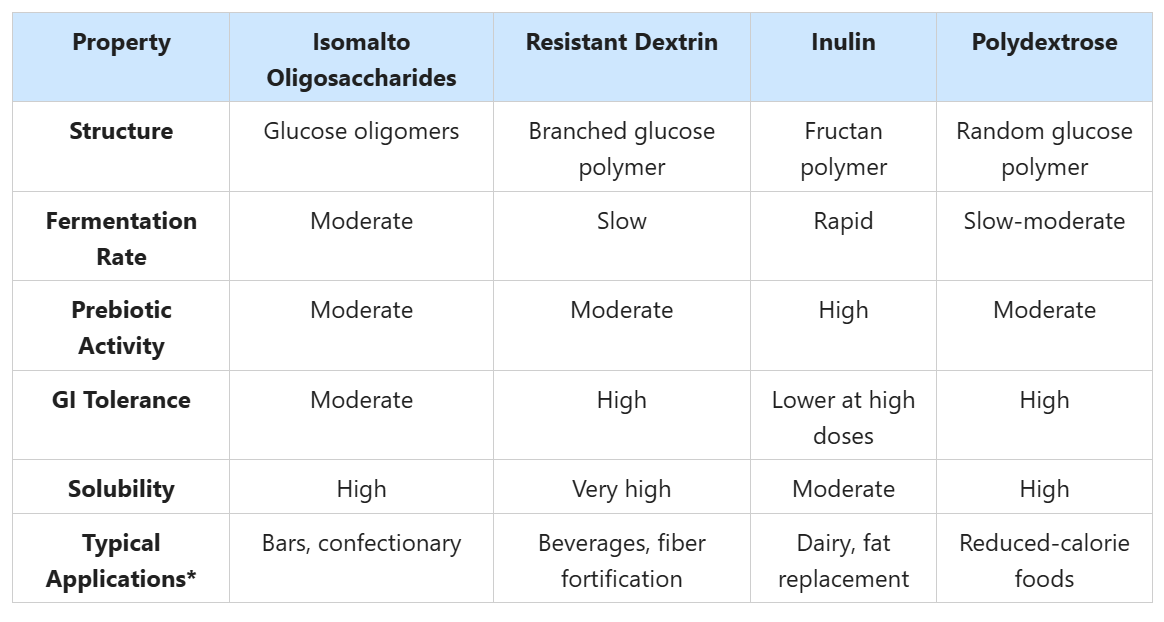
*This is not a comprehensive list of applications for these ingredients. Connect with a Top Health representative to learn how our fibers and prebiotics can work in your application