
For confectionery formulators, sugar reduction is never just a sweetness adjustment. Sugar contributes bulk, structure, crystallization behavior, water management, texture, and shelf-life stability. When sugar levels are reduced, each of those functions has to be accounted for elsewhere in the system. Successful sugar-reduction strategies require balacing sweetness, structure, moisture management, and shelf-life stability using carefully selected ingredients.
That challenge is becoming more important as brands respond to consumer demand for lower-sugar products, simpler ingredient lists, and more transparent nutrition labeling. At the same time, proposed front-of-package labeling changes are expected to increase visibility around sugar content, making formulation decisions more apparent at the point of purchase.
The difficulty is that reducing sugar narrows the formulation window. The finished product still needs to deliver the expected bite, chew, surface characteristics, and shelf life—without the functional backbone sugar typically provides.
When that system is not fully balanced, the same failure modes tend to appear. Sugar-reduced confectionery may crack after cooling, develop sticky surfaces over time, or lose stability as moisture redistributes.
These are not isolated issues. They are system-level problems.
As sugar reduction trends continue reshaping the confectionery market, formulators are under increasing pressure to develop sugar-reduced products that maintain the texture, stability, and sensory experience consumers expect from traditional confectionery.

What Sugar Actually Does in Confectionery Systems
Sugar serves multiple roles in traditional confectionery.
It provides the bulk and solids that define structure, participates in crystallization, which determines texture, helps regulate water activity and moisture distribution, and also contributes to binding and overall system cohesion.
No single ingredient can replace all of these functions when sugar is reduced or removed. Instead, formulators have to rebuild the system using multiple components that work together.
The confectionery will eventually show if any one of those functions is under-supported — often after processing, during cooling, or storage.
Failure Problem 1: Why Sugar-Reduced Candy Cracks
Cracking is typically a structural and crystallization issue, and it often appears after cooling rather than during processing.
In full-sugar systems, the crystalline structure and solids matrix help distribute stress as the product sets. That structure behaves differently in sugar-reduced systems, particularly those relying heavily on erythritol as a sweetener.
Erythritol provides clean-label sweetness and low glycemic impact, but it also has a strong tendency to recrystallize. This rapid crystallization can lead to rigid, brittle structures. Internal stress builds as the product cools and moisture equilibrates, causing the stress to be relieved through cracking if there isn't enough flexibility in the matrix.
This is why products may look acceptable immediately after production but fail during storage or distribution.
What improves stability
Addressing cracking requires rebuilding the structural network, not adjusting sweetness.
This usually involves:
- Adding a bulking component to replace solids and reduce brittleness
- Incorporating ingredients that disrupt crystallization or increase flexibility
- Avoiding over-reliance on a single crystalline sweetener
Maltodextrin, for example, can contribute bulk and act as a binding agent, helping to soften the structure and reduce fracture risk.
Allulose can also play a role by contributing solids, supporting browning, and helping create a softer, more cohesive texture in reduced-sugar systems.
The goal is to create a matrix that can absorb stress during cooling rather than fracture under it.
Failure Problem 2: Why Sugar-Reduced Gummies Become Sticky
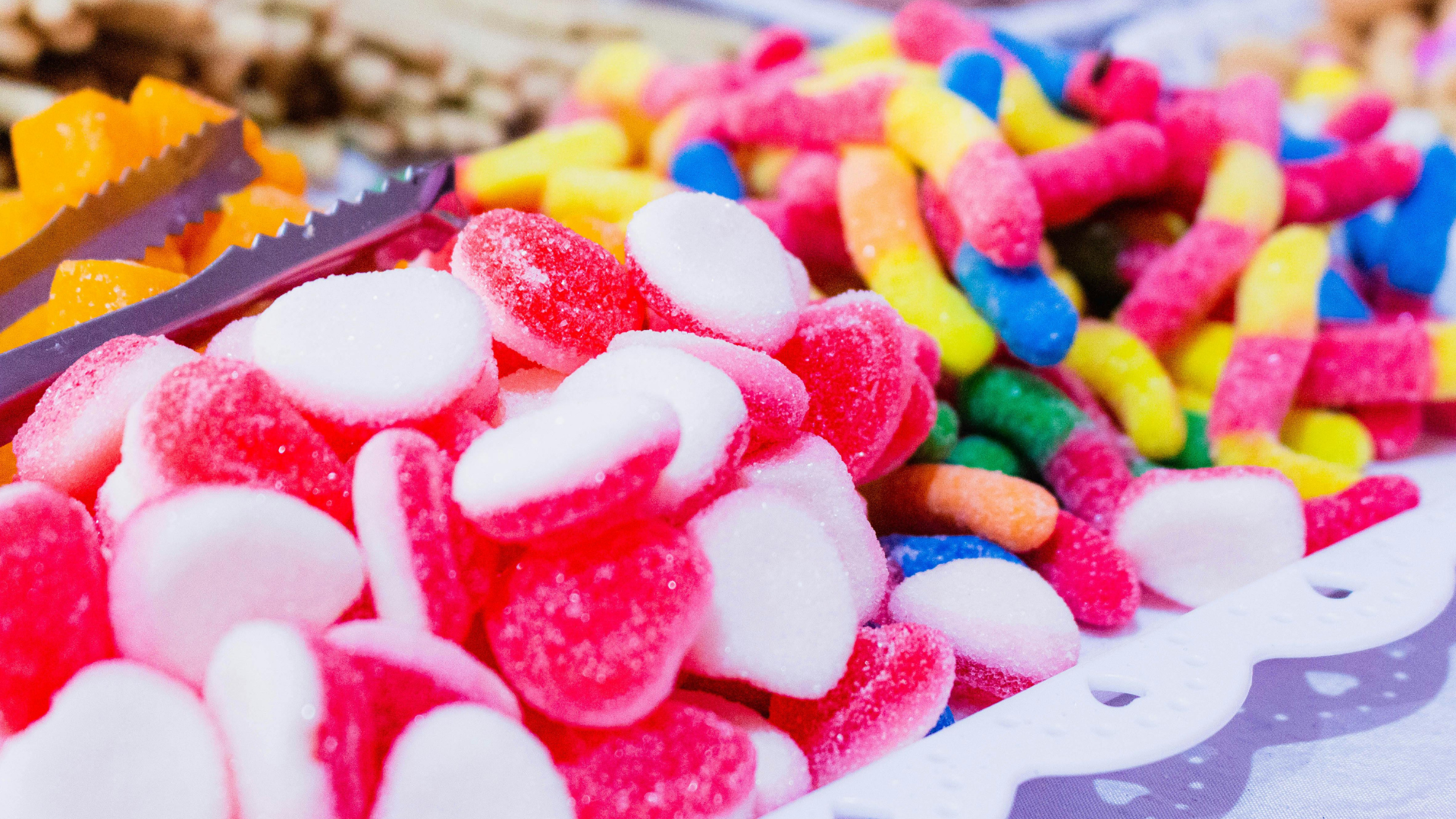
The more common failure mode in soft confectionery, such as gummies, is surface stickiness, often described as sweating, which is driven by moisture movement rather than crystallization.
Many reduced-sugar gummy systems rely on polyols such as sorbitol or maltitol, which are ingredients hygroscopic, meaning they readily absorb moisture. Over time, these ingredients can pull water toward the surface of the product, even after packaging, resulting in a sticky or wet exterior.
The sweating can lead to:
- Poor handling characteristics
- Texture breakdown
- Reduced shelf stability
What improves stability
Managing this issue requires controlling how water is held and distributed within the system.
Approaches include:
- Selecting ingredients with lower hygroscopicity
- Incorporating components that bind water more effectively within the matrix
- Using surface treatments or coatings to limit moisture migration
Functional carbohydrates such as resistant dextrin can play a role here due to their high solubility and ability to integrate into the system without significantly increasing viscosity. This allows them to support water distribution and stability without negatively impacting texture.
Similarly, ingredients like IMO can contribute to system cohesion and binding in certain applications, helping to stabilize the overall structure while maintaining a softer texture profile.
The key is not eliminating moisture, but ensuring it remains distributed within the product rather than moving to the surface.
Failure Problem 3: Water Activity and Shelf-Life Stability
Both cracking and stickiness are tied to a more fundamental concept: water activity.
Water activity measures the amount of free water available in a system. It is a better predictor of stability than total moisture content.
When water activity is too high, products become more susceptible to microbial growth and surface stickiness. When it is too low, products can become excessively hard or brittle. When different parts of a system are not in equilibrium, moisture migration occurs, leading to instability.
Maintaining target water activity ranges in reduced-sugar systems is more challenging because sugar is no longer present to help regulate water binding.
What improves stability
Stability comes from designing the system to manage water effectively.
This includes:
- Using ingredients that bind water without increasing stickiness
- Balancing solids and moisture to avoid gradients within the product
- Ensuring compatibility between ingredients to minimize migration over time
Resistant dextrin, for example, is highly soluble and contributes minimal viscosity while supporting overall system stability in certain applications.
Formulators want to maintain balance throughout the product over its shelf life.
Rebuilding the System: Bulk Sweetener Strategy
The formulation approach becomes clearer once formulators understand these issues.
Sugar reduction requires rebuilding a system using multiple functional components.
A typical approach includes:
- A sweetener system to deliver the desired sweetness profile
- A bulking system to replace solids and support structure
- A functional carbohydrate system to influence texture, binding, and moisture behavior
Each component serves a different role.
Erythritol provides sweetness but contributes to crystallization and brittleness if not balanced. Allulose provides bulk and supports softer textures and browning. Maltodextrin contributes structure, binding, and stability. Functional carbohydrates like IMO can support binding and mild sweetness in applications such as bars.
No individual ingredient solves all challenges, so stability comes from how the formulation is created.
Labeling Pressure and Ingredient Strategy
Formulation decisions are increasingly being shaped by how products will be evaluated on the label, not just how they perform in the system.
Consumers are already paying closer attention to added sugar and ingredient lists, and that scrutiny is likely to increase. Proposed front-of-package labeling changes are expected to make key nutrients like added sugars more visible at the point of purchase, shifting how products are compared on the shelf.
For formulators, that creates a more constrained design space. Reducing sugar is no longer just a nutritional objective because it becomes a visible product attribute that has to be addressed without introducing new tradeoffs.
At the same time, there is continued pressure to maintain ingredient lists that are:
- Recognizable
- Functionally justified
- Appropriate for the product category
In practice, this means formulations need to:
- Reduce or replace sugar in a meaningful way
- Maintain expected texture, stability, and shelf life
- Avoid overly complex or highly fragmented ingredient systems
These requirements are often in tension with each other, and as a result, ingredient selection is shifting toward components that can deliver multiple functional roles within the system. Ingredients that contribute to bulk, binding, moisture management, and stability while fitting within labeling expectations become more valuable as formulation constraints tighten.
If you’re developing sugar-reduced confectionery and running into structural or stability challenges, those issues are typically solvable with the right system design.
Contact Top Health Ingredients to request samples or discuss formulation strategies for your application.

A keto-friendly sugar substitute - not included as 'added' or 'total' sugars on nutritional labels! Available in both syrup and crystalline versions.

Soluble prebiotic that helps foster the growth of good gut bacteria - promoting a thriving microbiome